
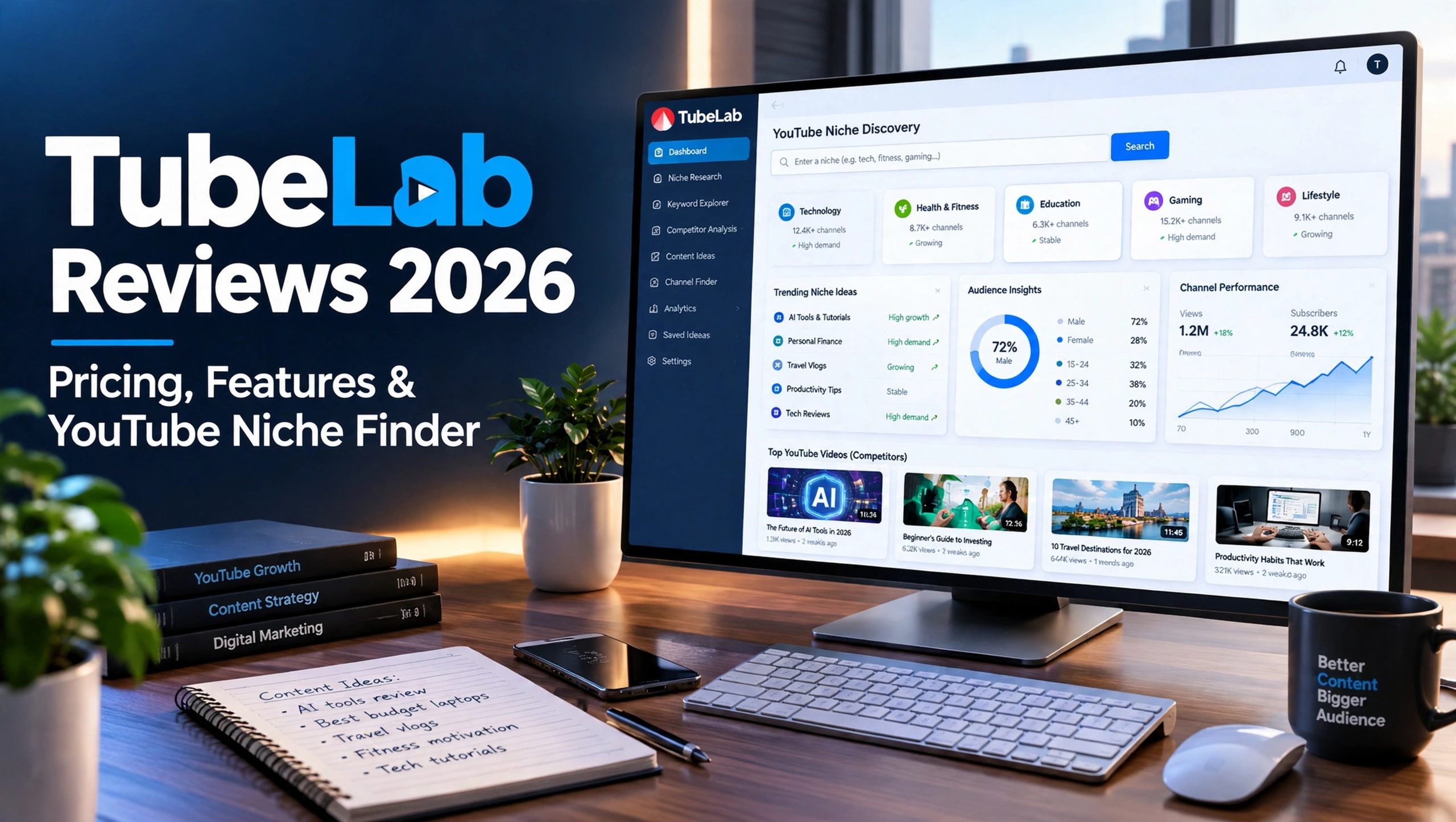

Finding the right YouTube niche can be one of the hardest parts of starting or growing a channel. A niche may look profitable on the surface, but competition, audience demand, search interest, and monetization potential can make a huge difference.
That is where TubeLab comes in.
TubeLab is designed to help YouTube creators research niches, discover content opportunities, analyze channel ideas, and make more informed decisions before investing time into creating videos. Instead of choosing a topic based only on personal interest, creators can use niche research and YouTube-focused data to identify opportunities worth exploring.
In this TubeLab review 2026, I’ll look at what TubeLab offers, how its YouTube niche finder works, its main features, pricing considerations, advantages and drawbacks, and some alternatives worth considering.
TubeLab at a Glance
| Feature | TubeLab |
|---|---|
| Platform | YouTube research and niche discovery |
| Main purpose | Find and research YouTube opportunities |
| Niche research | Yes |
| YouTube-focused tools | Yes |
| Content research | Yes |
| Channel research | Yes |
| Suitable for beginners | Yes |
| Useful for established creators | Yes |
| Best for | YouTube niche and content research |
What Is TubeLab?

TubeLab is a YouTube research platform built around the idea of making channel and niche research easier.
For new creators, one of the biggest challenges is deciding what type of content to create. There are thousands of possible topics, but not every topic has enough audience demand or a realistic path to growth.
TubeLab aims to simplify this research process by helping users explore YouTube niches and potential content opportunities.
Rather than manually opening dozens of YouTube channels and trying to compare them one by one, a dedicated research platform can make the process more structured.
This can be especially useful for creators who want to:
- Start a new YouTube channel
- Research profitable niches
- Validate a channel idea
- Find content opportunities
- Study competing channels
- Explore less competitive topics
- Build a repeatable YouTube research workflow
How Does TubeLab Work?
The basic idea behind TubeLab is straightforward.
You begin with a YouTube niche, topic, or channel concept that interests you. TubeLab then helps you research the opportunity around that idea.
Instead of asking only, “Do I like this niche?”, you can approach the decision from several angles.
For example, a creator might investigate:
- Audience demand – Is there an audience interested in the topic?
- Competition – How difficult could it be to establish a new channel?
- Content opportunities – Are there enough topics to create videos consistently?
- Existing channels – What are successful creators already doing?
- Potential growth opportunities – Are there underserved areas within the niche?
TubeLab YouTube Niche Finder

One of the most interesting aspects of TubeLab is its focus on YouTube niche research.
Choosing a niche is often more complicated than simply selecting a popular category.
For example, “technology” is an enormous niche. A new creator could potentially narrow it down into areas such as:
- AI tools
- Smartphone tutorials
- Budget gadgets
- Productivity software
- PC accessories
- AI news
- Software tutorials
A YouTube niche finder can help creators move from a broad idea toward more specific opportunities.
Why Niche Research Matters
A good YouTube niche should ideally provide enough potential topics for long-term content.
You also want to understand whether people actually watch content in that category.
This is why niche research should happen before creating a channel rather than after publishing dozens of videos.
TubeLab can be useful here because it gives creators a dedicated environment for exploring YouTube opportunities.
TubeLab Features
1. YouTube Niche Research
Niche research is one of the main reasons creators may consider TubeLab.
Instead of randomly selecting a category, you can research different ideas and compare potential opportunities.
This can be useful for both beginners and experienced creators who are considering launching a second channel.
2. Content Opportunity Research
Finding a niche is only the first step.
Once you select a niche, you need enough video ideas to keep publishing.
TubeLab’s research-oriented approach can help creators investigate what types of content are already attracting attention and where there may be opportunities for new videos.
This can help turn a general niche into a more practical content strategy.
3. YouTube Channel Research
Studying successful YouTube channels is an important part of competitor research.
Creators can learn from established channels by looking at their content direction, topics, formats, and overall positioning.
The goal isn’t to copy another creator.
Instead, research can reveal patterns that help you understand what audiences in a particular niche respond to.
4. Competitor Analysis
Competition is unavoidable on YouTube.
However, competition isn’t necessarily a reason to abandon a niche.
A better approach is to understand what competitors are doing and look for gaps.
For example, you might discover that competitors focus heavily on beginner tutorials while there is less content for advanced users.
That difference can become a potential content angle.
5. Niche Validation
One of the biggest benefits of using a YouTube research tool is the ability to validate an idea before committing significant time to it.
You can research multiple niches and compare them rather than immediately choosing the first idea that sounds interesting.
This is particularly valuable for creators who want to build YouTube channels as long-term projects.
6. Research for New Channel Ideas
TubeLab can also be useful if you don’t know what type of YouTube channel to start.
Instead of starting with a channel name or logo, you can start with research.
Explore different categories, investigate existing channels, and identify areas where you believe you can provide something useful or different.
TubeLab for Beginners

TubeLab can be particularly interesting for beginners because starting a YouTube channel can feel overwhelming.
A new creator has to make several decisions:
- What niche should I choose?
- Who is my audience?
- What videos should I make?
- How competitive is the niche?
- How often should I publish?
- What types of channels already exist?
- Is there enough content potential?
A niche research platform gives beginners a more organized starting point.
However, tools cannot replace actual content quality. Even if a niche looks promising, the creator still needs good videos, compelling titles and thumbnails, consistency, and an understanding of the audience.
TubeLab for Experienced YouTubers
TubeLab isn’t only relevant to people starting their first channel.
Experienced creators can also use niche research when they want to:
- Launch another channel
- Enter a new category
- Test a new content direction
- Research competitors
- Discover sub-niches
- Find new video opportunities
- Expand an existing audience
TubeLab Pros and Cons
Pros
- Focuses specifically on YouTube research
- Helps with niche discovery
- Useful for validating channel ideas
- Can support competitor research
- Helps creators explore content opportunities
- Suitable for beginners and experienced creators
- Encourages data-driven niche selection
- Can reduce random guesswork when choosing a niche
Cons
- Research tools cannot guarantee channel success
- Beginners may still need to learn YouTube fundamentals
- Some niche opportunities can be highly competitive
- Data should be combined with manual research
- The value depends on how frequently you use the platform
- Creators still need strong content and consistent execution
Is TubeLab Easy to Use?
Ease of use matters because YouTube research can become complicated very quickly.
A useful research platform should help you move from an idea to actionable information without requiring a large amount of manual work.
TubeLab’s niche-focused approach makes it more straightforward than trying to build an entire research process from scratch.
That said, beginners should still expect a learning curve.
The most important thing is understanding what the research actually means.
A high-interest niche isn’t automatically a good niche for every creator. Likewise, a competitive niche isn’t automatically impossible.
The data needs to be interpreted within the context of your skills, audience, content format, and goals.
TubeLab Reviews: What Should You Look For?
When reading TubeLab reviews, it is important to separate the software itself from expectations about YouTube growth.
A research tool can provide useful information, but it cannot guarantee:
- Viral videos
- Subscribers
- Watch time
- YouTube Partner Program approval
- Ad revenue
- Sponsorships
- A successful channel
The strongest use case for TubeLab is therefore research and decision support rather than treating it as an automatic YouTube growth solution.
TubeLab vs Manual YouTube Research
You can research YouTube niches without TubeLab.
YouTube itself provides a huge amount of information. You can manually search keywords, examine competing channels, inspect video topics, compare views, and identify recurring patterns.
The problem is time.
Manual research can require opening many channels and videos and keeping notes separately.
A dedicated platform can make the workflow more structured.
Manual Research
- Usually free
- Highly flexible
- Can take considerable time
- Requires organizing information yourself
- Easy to become inconsistent
TubeLab
- Built around YouTube research
- More structured workflow
- Designed for niche exploration
- Can reduce repetitive research
- Requires a subscription or paid access depending on the plan
For creators who repeatedly investigate niches and content opportunities, a dedicated research platform can make more sense.
TubeLab Pricing

Pricing is an important consideration when evaluating any YouTube research platform.
TubeLab’s pricing and available plans can change over time, so creators should check the current official pricing before subscribing.
When comparing a TubeLab plan, don’t look only at the monthly price.
Consider what you actually need from the platform.
For example, someone researching a single channel idea may have very different requirements from a creator managing several channels and researching new niches every week.
Before paying for a plan, consider:
- How often you will use the tool
- Which research features you need
- Whether usage limits apply
- Whether the plan supports your number of projects
- Whether the subscription fits your content workflow
- Whether you can cancel or change plans easily
TubeLab Alternatives
TubeLab isn’t the only way to research YouTube.
Depending on your goals, you may also want to consider other YouTube research and creator tools.
1. vidIQ
vidIQ is a well-known YouTube creator platform that offers tools for keyword research, video ideas, channel optimization, and competitive research.
It can be particularly useful for creators who want a broader collection of YouTube growth features.
2. TubeBuddy
TubeBuddy provides a range of YouTube optimization and channel-management tools.
It can be useful for creators who want help with keyword research, video optimization, testing, and channel workflows.
3. YouTube Studio
For creators who already have a channel, YouTube Studio should not be overlooked.
It provides first-party information about your own audience, videos, traffic sources, watch time, and other channel metrics.
It won’t replace every niche research tool, but it is essential for understanding what is actually happening on your channel.
4. Google Trends
Google Trends can help creators investigate whether interest in a topic is increasing, decreasing, or changing over time.
It can be especially useful when researching broader topics before turning them into YouTube content ideas.
How to Get Better Results From TubeLab
Using a research tool effectively is more important than simply having access to one.
Start Broad
Begin with several broad categories instead of committing immediately to one idea.
Narrow the Topic
Once you find an interesting category, look for smaller sub-niches.
Study Existing Channels
Look at what successful channels are publishing and identify recurring themes.
Search for Content Gaps
Don’t simply copy popular videos. Look for questions, audiences, formats, or topics that appear underserved.
Test Your Ideas
Research is useful, but actual publishing provides additional information.
Use your first videos to learn what your audience responds to.
Revisit Your Research
YouTube trends change.
A niche that looks promising today can become much more competitive later, while new opportunities can appear unexpectedly.
Final Verdict on TubeLab
TubeLab is an interesting option for creators who want to take a more research-driven approach to YouTube.
Its biggest appeal is the focus on YouTube niche discovery, channel research, competitor analysis, and content opportunities. Instead of choosing a niche based entirely on intuition, creators can use research to make their decisions more systematic.
For beginners, this can provide a useful framework for deciding where to start. For experienced creators, it can help when exploring new channels, sub-niches, and content directions.
However, no YouTube research tool can guarantee growth.
If you use TubeLab as part of a broader workflow that includes audience research, content creation, thumbnail testing, analytics, and consistent publishing, it can become a useful part of your YouTube strategy.
