

Growing a YouTube channel is no longer just about uploading good videos. Creators also need to understand YouTube SEO, keyword research, competition, video ideas, titles, tags, thumbnails, and audience behavior.
That is where YouTube growth tools can help.
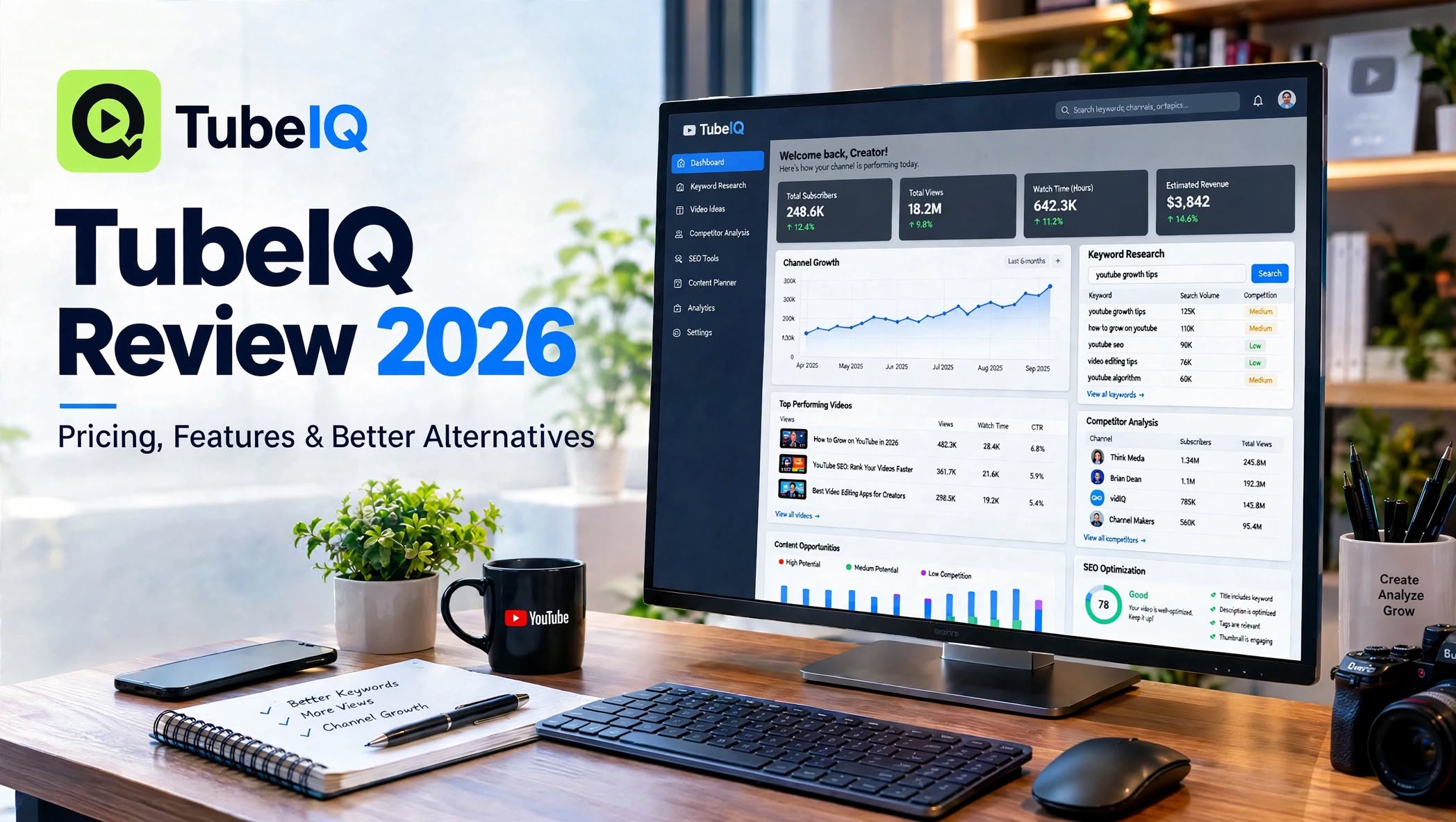
TubeIQ is designed to give YouTube creators data and insights that can help them research content opportunities, improve video optimization, and make more informed decisions about their channels.
But is TubeIQ actually useful for YouTube growth in 2026? What does TubeIQ cost, what features does it offer, and are there better alternatives?
In this TubeIQ review, I’ll break down its main features, pricing considerations, advantages, limitations, and alternatives so you can decide whether it fits your YouTube workflow.
What Is TubeIQ?

TubeIQ is a YouTube research and optimization tool aimed at creators who want to improve their channel strategy using data instead of relying entirely on guesswork.
The platform focuses on areas such as:
- YouTube keyword research
- Video and topic research
- Competitor analysis
- Content ideas
Instead of randomly publishing videos and waiting to see what happens, a research tool like TubeIQ can help identify topics and search opportunities worth investigating.
That makes it potentially useful for beginners, established creators, niche-channel owners, and marketers working with YouTube content.
TubeIQ Highlights
Here are the main things to know about TubeIQ:
- YouTube-focused research and optimization
- Keyword and topic discovery
- Competitor research
- Content planning support
- Video SEO insights
- Useful for researching niches before creating videos
TubeIQ Features
YouTube Keyword Research
Keyword research is one of the most important parts of YouTube SEO.
TubeIQ can help creators investigate keywords and search phrases related to their niche. This can make it easier to understand what people are searching for and discover topics that could potentially attract viewers.
Instead of choosing a video topic simply because it sounds interesting, creators can use keyword research as another source of information when planning content.
For example, a creator in the fitness niche could research different variations of terms related to home workouts, weight training, nutrition, or beginner exercises.
The goal isn’t to chase every high-volume keyword. More useful research combines search interest with relevance, competition, and the creator’s ability to produce a strong video.
YouTube Video Research
TubeIQ can also be useful when researching existing YouTube content.
Studying videos already performing within a niche can reveal patterns in:
- Topics
- Titles
- Keywords
- Content angles
A successful video can provide a clue about what viewers are interested in, but the best approach is to develop a different and more useful angle.
Competitor Analysis

Competitor research is another important part of YouTube growth.
TubeIQ can help creators examine channels and content within their niche to better understand what other creators are publishing.
You can use competitor research to look for patterns such as:
- Frequently covered topics
- Popular content formats
- Repeated keywords
- Content gaps
- Potentially overlooked subjects
Rather than asking, “What should I upload?”, you can start asking more specific questions such as:
What topics are competitors covering repeatedly, and where are there opportunities to provide something different?
Content Ideas
Coming up with new YouTube ideas consistently can become difficult.
Research tools can help generate inspiration by showing related searches, topics, and existing content.
For creators who publish several videos every week, this can reduce some of the time spent brainstorming.
However, data should support your content strategy rather than completely replace creativity.
A keyword may have search demand, but that does not automatically mean it will produce an engaging video.
YouTube SEO
YouTube SEO involves much more than adding keywords to a description.
Your topic, title, thumbnail, video structure, audience retention, engagement, and overall viewer satisfaction can all influence how a video performs.
TubeIQ can assist with the research side of this process by helping creators investigate keywords and content opportunities.
The actual quality of the video still depends on the creator.
How Does TubeIQ Work?
Getting value from TubeIQ generally comes down to using it as part of a broader YouTube workflow.
A practical process looks like this:
Step 1: Choose Your Niche
Start with a specific niche or audience.
For example:
- Personal finance
- Fitness
- Gaming
- Technology
- AI tools
Step 2: Research Keywords
Enter relevant topics and keywords to discover potential search terms and content ideas.
Look beyond the biggest keywords. Smaller, more specific topics can sometimes provide better opportunities for newer channels.
Step 3: Analyze Existing Videos
Look at videos already targeting the topic.
Study what competitors are doing well and identify areas where your content could offer something more useful, clearer, newer, or more entertaining.
Step 4: Build a Video Idea
Turn the research into a specific video concept.
Instead of creating a generic video around a broad keyword, create a focused topic that answers a particular viewer need.
Step 5: Optimize the Video
Use your research when creating the title, description, tags where relevant, and overall content structure.
But don’t over-optimize.
A title should make sense to humans first. Keyword placement should feel natural rather than forced.
Step 6: Track Results
After publishing, monitor the video’s performance and learn from the data.
YouTube growth usually comes from repeatedly testing topics, packaging, and content quality rather than finding one perfect keyword.
TubeIQ Pros and Cons
Pros
- Focused on YouTube research
- Helps with keyword discovery
- Useful for competitor research
- Can support content planning
- Helps reduce guesswork
- Useful for both new and growing channels
- YouTube-specific workflow
Cons
- Data alone cannot guarantee channel growth
- Some features may be more useful to experienced creators
- Subscription cost may not suit casual users
- Beginners may need time to understand the research data
- Results still depend heavily on video quality and audience engagement
Who Is TubeIQ Best For?

TubeIQ can be useful for:
New YouTubers
Beginners often struggle with choosing topics and understanding YouTube SEO. Research tools can provide a more structured starting point.
Growing YouTube Channels
Channels that already publish regularly can use research to improve their content planning and identify additional opportunities.
YouTube SEO Specialists
SEO professionals managing multiple channels can benefit from dedicated research and competitor-analysis features.
Content Agencies
Agencies producing YouTube content for clients may find research tools useful for organizing topic and keyword discovery.
Niche Channel Creators
Creators working in competitive niches can use competitor research and keyword analysis to find more specific content opportunities.
TubeIQ vs Manual YouTube Research
You don’t necessarily need a paid tool to research YouTube.
You can manually study:
- YouTube search suggestions
- Competitor channels
- Popular videos
- Comments
- Related searches
- Google Trends
- YouTube Analytics
Instead of switching between several sources and manually collecting information, a dedicated tool can bring more research functions into a single workflow.
The trade-off is cost.
If you only publish occasionally, manual research may be sufficient. If YouTube is an important part of your business, a dedicated research platform can save time.
TubeIQ Alternatives
TubeIQ isn’t the only option for YouTube research and optimization.
Depending on your needs, you may also want to consider other established YouTube-focused tools.
TubeBuddy
TubeBuddy provides a broad collection of YouTube optimization and channel-management features.
It can be useful for creators who want keyword research, SEO assistance, productivity tools, and channel-management features in one platform.
vidIQ
vidIQ is another well-known YouTube growth platform with tools for keyword research, video ideas, competitor analysis, and channel optimization.
It is particularly relevant for creators who want a broader set of AI-assisted and research features.
Google Trends
Google Trends is a free option for researching interest in topics over time.
It doesn’t provide the same dedicated YouTube workflow as a specialized platform, but it can be useful for identifying trends and comparing topics.
YouTube Analytics
For creators who already have a channel, YouTube Analytics should not be overlooked.
It provides first-party information about your own audience, videos, traffic sources, watch time, and other performance metrics.
In many cases, combining YouTube Analytics with a research tool gives creators a more complete picture.
TubeIQ vs TubeBuddy vs vidIQ
| Feature | TubeIQ | TubeBuddy | vidIQ |
|---|---|---|---|
| YouTube research | Yes | Yes | Yes |
| Keyword research | Yes | Yes | Yes |
| Competitor research | Yes | Yes | Yes |
| Content ideas | Yes | Yes | Yes |
| SEO support | Yes | Yes | Yes |
| Channel analytics | Depends on plan | Yes | Yes |
| AI features | Depends on plan | Available | Available |
| Best use | YouTube research | Optimization & management | Growth & research |
The right choice depends on your workflow rather than simply the number of features.
TubeIQ Pricing

TubeIQ pricing can vary depending on the plan, features, promotions, and current subscription structure.
Before purchasing, it is worth checking the latest pricing directly on the official TubeIQ website because software pricing and included features can change.
When comparing plans, pay attention to:
- Keyword research limits
- Number of channels supported
- Competitor research limits
- Available SEO tools
- Historical data
How to Get Better Results With TubeIQ
A research tool works best when you use it strategically.
Don’t Chase Only High-Volume Keywords
High search volume often means high competition.
Long-tail and highly specific topics may be easier to target, especially for smaller channels.
Study Search Intent
Understand why someone is searching for a particular topic.
If someone searches “best camera for YouTube,” they may want product recommendations. Someone searching “how to edit YouTube videos” probably wants a tutorial.
Your video should match the reason behind the search.
Analyze Competitors
Don’t copy successful videos.
Instead, look for patterns and identify how you can improve on the information, presentation, examples, or production quality.
Create Better Titles and Thumbnails
SEO can help people discover your content, but packaging helps convince them to click.
A strong title and thumbnail should accurately communicate the value of the video without making misleading promises.
Use Your Own Analytics
Third-party research can tell you what might work.
Your own YouTube Analytics can tell you what your audience actually watched and engaged with.
Use both.
Is TubeIQ Worth It?
Whether TubeIQ is worth paying for depends largely on how seriously you are approaching YouTube.
If you are building a channel as a hobby and upload only occasionally, free research methods may be enough.
If you’re publishing consistently and spending significant time researching keywords, competitors, and video ideas, a dedicated YouTube research platform can make the process more organized.
The important thing to remember is that TubeIQ cannot guarantee YouTube growth.
A successful channel still depends on the combination of:
- Strong topics
- Useful or entertaining videos
- Effective titles
- Attractive thumbnails
- Viewer retention
Final Verdict: TubeIQ Review 2026
TubeIQ is a YouTube-focused research and optimization platform built around an important problem: helping creators make more informed content decisions.
Its keyword research, competitor analysis, content research, and SEO-oriented workflow can be useful for creators who want to move beyond random topic selection.
For beginners, the biggest benefit may be having a more structured way to research potential video ideas. For experienced creators, the value comes from using research alongside existing channel analytics and content-testing processes.
However, no YouTube SEO tool can guarantee views or subscribers.
If you are serious about growing a channel, TubeIQ can be considered as one part of a broader strategy that combines research, strong content, compelling thumbnails, effective titles, and continuous performance analysis.
Before subscribing, compare its current features and pricing with alternatives such as TubeBuddy and vidIQ to make sure the available tools match your particular YouTube workflow.
