

Building a mobile app traditionally requires a combination of product planning, UI/UX design, coding, backend development, testing, and deployment. For beginners and even experienced product teams, that process can take significant time before a working version is ready.
Rork AI takes a different approach.
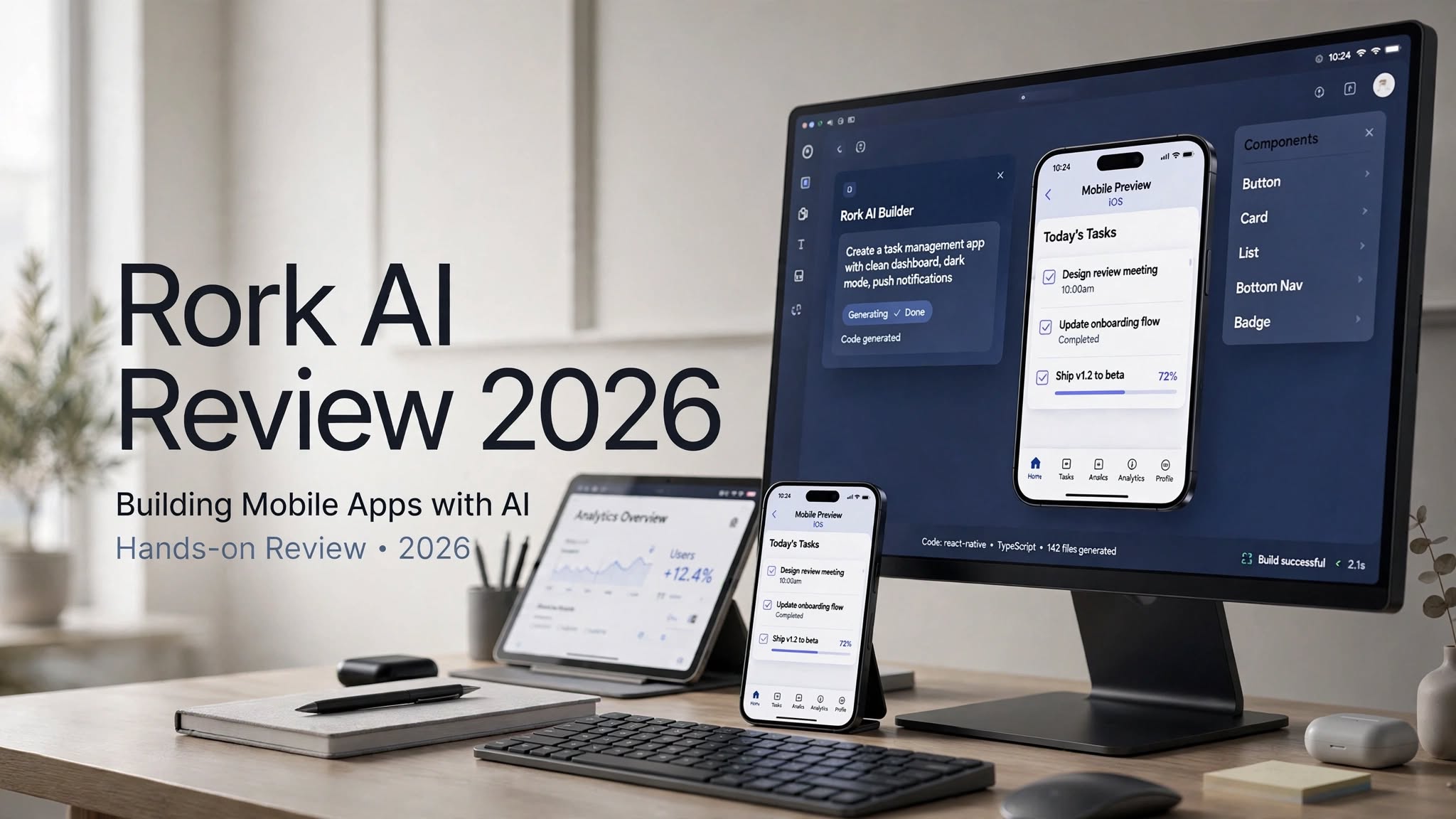
Instead of beginning with a blank development environment, Rork lets you describe your application in natural language and uses AI to help turn the idea into a functional app. The platform is designed around conversational development, making it possible to describe screens, features, workflows, and changes without manually writing every line of code.
In this Rork AI review 2026, we’ll look at what Rork does, its main features, app-building workflow, pricing, advantages and limitations, and who can benefit most from using it.
What Is Rork AI?

Rork is an AI-powered application builder focused on helping users create functional mobile and web applications through natural-language instructions.
Rather than requiring you to build everything manually, Rork allows you to explain what you want to create and then work with the AI through an iterative development process.
You can start with a simple concept such as:
“Create a habit-tracking app where users can create daily goals, receive reminders, and see their progress.”
From there, you can continue refining the application by asking the AI to add screens, change the design, connect services, modify navigation, or introduce additional functionality.
Rork supports different development approaches for mobile and web projects, making it more than a simple visual prototype generator.
Rork AI Review: How Does It Work?
The basic Rork workflow is built around conversation.
Instead of writing code for every individual component, you explain the desired result and allow the AI to handle much of the implementation.
A typical workflow looks like this:
- Start with your app concept.
- Describe the target users and primary functionality.
- Ask Rork to create the initial version.
- Review the generated interface.
- Test the application.
Rork AI Features

1. AI-Powered App Builder
The central feature of Rork is its AI-assisted development environment.
You can describe your requirements in everyday language rather than manually implementing every screen and interaction.
For example, you could request:
- A user registration page
- An onboarding experience
- A dashboard
- Bottom navigation
- User profiles
The important part is that development can remain conversational. If something doesn’t look or behave the way you want, you can continue explaining the problem rather than rebuilding the entire project manually.
2. Native Mobile App Development
One of Rork’s notable features is its focus on actual mobile applications.
Rork supports development workflows for both iOS and Android, allowing users to create applications intended for mobile devices rather than simply designing static screens.
This is particularly useful for entrepreneurs who want to validate a mobile product idea before committing to a larger development project.
3. iOS Development With Rork
Rork Max is designed around Apple’s native development ecosystem and uses SwiftUI for native Apple applications.
This opens the door to applications that need more than a basic mobile interface.
Depending on the project, developers can work with Apple-specific capabilities and experiences rather than treating the app as nothing more than a mobile website.
For product designers, this is especially interesting because the design process can move closer to an actual native product experience.
4. Android App Development
Rork also supports Android development using technologies including Kotlin and Jetpack Compose.
This means Android projects can be created with a modern native development approach.
Mobile functionality can include capabilities such as:
- Camera access
- Location
- Bluetooth
- Local storage
5. Web App Development
Rork is not exclusively a mobile app builder.
It can also be used for web application projects, giving creators another way to turn their concepts into functional digital products.
For startups, this flexibility can be useful because a product may begin as a web MVP and later expand into native mobile applications.
6. Database Integration
Most useful applications need somewhere to store information.
Rork supports integrations with services such as Supabase and Firebase, allowing applications to work with user accounts, stored information, application data, and other backend functionality.
This is important because generating attractive screens is only one part of building a real application.
The ability to connect the interface to a backend makes Rork more practical for MVP development.
7. API Integrations
Modern applications frequently rely on external services.
Rork can be used with APIs to connect applications to third-party platforms and services.
This can be useful for apps involving:
- AI models
- Payments
- Maps
- Data services
8. AI-Powered Features
Rork can also be used to create applications that themselves contain AI features.
For example, you could build an application around:
- AI chat
- AI assistants
- Image generation
- AI content tool
Rork AI for Product Designers
From a product-design perspective, Rork is particularly interesting because it changes where the development process begins.
Traditional development often starts with technical questions:
Which framework should we use?
With an AI app builder, the starting point can instead be:
What problem are we solving?
This can make early-stage experimentation much faster.
A product designer can focus on user journeys, information architecture, interaction design, and visual hierarchy while using AI to help implement the experience.
However, good product design is still necessary.
AI can generate an interface, but it doesn’t automatically mean that the interface is useful, intuitive, or appropriate for the target audience.
Using Figma With Rork
Designers who already work with Figma may find the design-to-development workflow particularly useful.
Rather than describing every visual detail from scratch, designers can provide existing design references and use them as a starting point for implementation.
This can help reduce the distance between:
Figma design → functional prototype → working application
For teams that already have established UI designs, this can make experimentation more efficient.
Rork AI for Beginners

One of Rork’s biggest attractions is accessibility.
Someone who understands their product idea but has limited programming experience can start with a conversational description instead of learning an entire development stack first.
For example, a beginner could explain:
“I want a personal finance app with a dashboard showing monthly spending, categories for expenses, and a simple savings goal.”
The AI can then create an initial version that the user can inspect and refine.
This does not mean beginners never need technical knowledge.
As an application becomes more complicated, understanding databases, APIs, authentication, security, deployment, and debugging becomes increasingly useful.
Rork makes the starting point easier, but production software can still be complex.
Rork AI Pros and Cons
Pros
- Natural-language app development
- Supports mobile and web projects
- Useful for rapid MVP development
- Native iOS development options
- Android development support
- Database integrations
- API integrations
- AI functionality
- Figma-based design references
- Useful for non-technical founders
- Helpful for rapid product experimentation
- Code can be taken into a broader development workflow
Cons
- AI-generated code still needs testing
- Complex apps may require many iterations
- Prompt quality can affect results
- Large projects can consume more AI credits
- Production applications may still require developers
- AI does not replace detailed UX research
- Advanced functionality may require higher-tier plans
Is Rork AI Good for Building an MVP?
Yes, an MVP is one of the most logical use cases for an AI application builder.
Imagine you have an idea for a marketplace, productivity app, fitness tracker, community platform, or AI assistant.
Instead of spending months developing every feature before receiving feedback, you can use Rork to create an initial version, show it to potential users, and learn which features actually matter.
This can help answer important questions early:
- Do users understand the product?
- Is the onboarding process clear?
- Which features are actually useful?
- Where do users get confused?
- What should be removed?
- What should be developed next?
What Can You Build With Rork AI?
The range of potential projects is broad.
Productivity Apps
You can create task managers, planners, habit trackers, note-taking tools, calendars, and personal organization applications.
Business Applications
Rork can be used to prototype dashboards, CRM tools, inventory systems, scheduling applications, internal tools, and workflow software.
AI Applications
You can create AI assistants, content-generation tools, image applications, voice-based products, and other AI-powered experiences.
Consumer Applications
Potential projects include social applications, community platforms, lifestyle products, educational tools, and utility applications.
Mobile Utilities
Rork can also be used for practical mobile applications involving cameras, location, device capabilities, notifications, and other mobile functionality.
Rork AI vs Traditional Development
Rork does not completely replace traditional software development.
Instead, it changes how quickly you can get started.
With traditional development, the process may look like:
Research → Product requirements → UX design → UI design → Development → Backend → Testing → Deployment
With an AI-assisted workflow, several of these stages can overlap.
You can move from:
Idea → Prompt → Prototype → Feedback → Iteration
much faster.
That can be particularly useful during the early stages of a product.
However, complex production applications still require careful engineering, security reviews, performance testing, maintenance, and long-term technical planning.
Who Should Use Rork AI?
Startup Founders
Rork can help founders turn an idea into an interactive MVP before investing heavily in development.
Product Designers
Designers can use it to experiment with functional versions of their concepts instead of stopping at static mockups.
Entrepreneurs
People with strong business ideas but limited programming experience can use Rork to participate more directly in the development process.
Developers
Developers can use AI-assisted generation for prototypes, initial structures, experiments, and repetitive implementation tasks.
Small Businesses
Small companies can explore internal tools and customer-facing applications without immediately building a large development team.
Rork AI Pricing

Rork uses a combination of free and paid plans.
The pricing structure is based largely around factors such as AI usage, credits, available models, and development capabilities.
Paid plans are intended for users who need more capacity or advanced functionality.
Because AI development can involve many iterations, the credit system is something users should pay attention to before choosing a subscription.
A small prototype may require relatively little usage, while a larger application that is repeatedly modified can consume considerably more resources.
For that reason, the most appropriate Rork plan depends heavily on the size and complexity of your project.
Who May Not Need Rork?
Rork may not be necessary for every development project.
If you already have an experienced engineering team and a mature development infrastructure, traditional tools may provide the precise control your team requires.
Similarly, extremely complex applications with unusual architecture, demanding performance requirements, or extensive enterprise infrastructure may require conventional engineering from the beginning.
Rork is most interesting when speed, experimentation, and accessibility are major priorities.
Final Thoughts on Rork AI
Rork AI is an interesting approach to modern app development because it puts the product idea ahead of the code.
Instead of spending the first stage of a project setting up development environments and writing boilerplate, users can begin by explaining what they want to build.
Its combination of AI-assisted development, mobile support, web capabilities, integrations, backend functionality, and design workflows makes it useful for experimenting with real products rather than only creating static concepts.
For beginners, Rork can lower the initial technical barrier. For designers, it can help turn visual ideas into functional experiences. For founders, it can provide a faster route toward an MVP.
The important thing is to keep realistic expectations.
AI can accelerate development, but product strategy, UX decisions, testing, security, and engineering quality still matter.
Overall, Rork is worth exploring if your goal is to build, test, and iterate on mobile or web app ideas with an AI-first development workflow.
Frequently Asked Questions About Rork AI
What is Rork AI?
Rork is an AI-powered application builder that lets users create and modify mobile and web applications using natural-language instructions.
Can Rork build iOS apps?
Yes. Rork provides an iOS development workflow, while Rork Max focuses on native Apple development using SwiftUI.
Can Rork build Android apps?
Yes. Rork supports Android development and can work with native Android technologies such as Kotlin and Jetpack Compose.
Do you need coding experience to use Rork?
No. Rork is designed to be accessible through natural-language instructions. However, technical knowledge becomes more useful as your application becomes more complex.
