
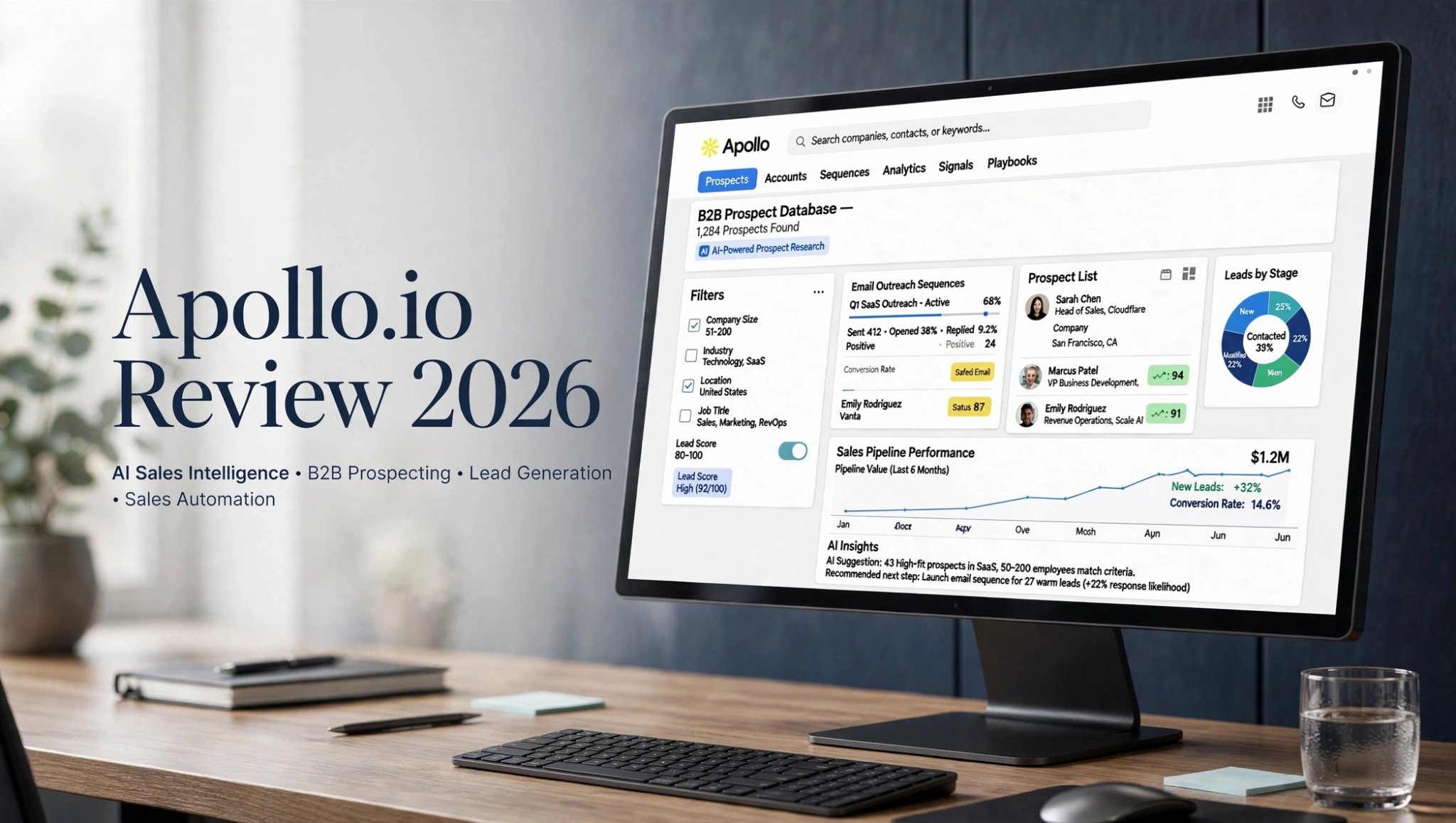

Finding the right B2B prospects is only one part of building a successful sales pipeline. Sales teams also need reliable contact data, effective outreach tools, lead intelligence, automation, and a way to understand which prospects deserve attention first.
Apollo.io brings many of these functions together in one platform. Instead of relying on separate tools for prospect discovery, contact enrichment, email outreach, sales engagement, and AI-assisted research, businesses can manage much of their go-to-market workflow from Apollo.
The platform has also expanded its AI capabilities significantly in 2026. Apollo now positions itself as an AI-powered go-to-market system that combines a large B2B database with intelligence and execution tools. Its current database includes more than 240 million contacts and 30 million accounts, while its AI features can help with prospect research, list building, personalization, workflow automation, and sales execution.
In this Apollo.io review 2026, we’ll look at its major features, AI capabilities, prospecting tools, outreach automation, integrations, pricing approach, pros and cons, and who the platform may be suitable for.
What Is Apollo.io?

Apollo.io is a B2B sales intelligence and go-to-market platform designed to help businesses find prospects, research accounts, build lead lists, personalize outreach, automate sales activities, and manage parts of their sales workflow.
One of its biggest advantages is the combination of B2B contact data and sales engagement tools. Apollo says its database contains more than 240 million contacts and supports more than 65 data attributes for prospect filtering. Users can search for contacts and companies based on criteria such as job role, company characteristics, personas, and buying signals.
Apollo also goes beyond traditional lead databases. Its AI features can help users research prospects, create lists, personalize emails, prioritize leads, and automate parts of outbound campaigns.
This makes Apollo particularly relevant to sales development representatives, revenue teams, agencies, startups, and businesses running outbound B2B sales campaigns.
Apollo.io Highlights
- 240M+ B2B contacts and 30M+ accounts
- AI-powered prospect research and lead generation
- More than 65 prospecting filters
- AI-assisted lead scoring and prioritization
- Email sequences and sales automation
- AI-powered email personalization
- Sales dialer and call management tools
- Buying intent and other prospect signals
- CRM and third-party integrations
- AI Assistant for sales workflows
- Data enrichment and contact management
- Analytics and sales performance insights
- Free plan and free-trial options on eligible paid plans
Apollo.io AI Features
 AI is now a major part of Apollo’s platform rather than being limited to a single standalone feature.
Apollo describes Apollo AI as a collection of intelligent tools integrated throughout the platform. These tools can assist with prospecting, writing, research, lead scoring, workflow creation, and sales automation.
AI-Powered Prospect Research
Researching prospects manually can consume a significant amount of time. Apollo AI can help sales teams gather information about people and companies and use those insights to support more relevant outreach.
Its AI Research capabilities can surface information about prospects, identify potential pain points, and help sales representatives create more personalized messaging.
AI Lead Generation
Apollo allows users to search for prospects using traditional filters as well as AI-assisted workflows.
Instead of manually building every filter combination, users can describe what they are looking for and use Apollo’s AI capabilities to help identify suitable prospects.
This can make prospect discovery more efficient when sales teams have a clearly defined ideal customer profile.
AI Email Personalization
Generic cold emails can be difficult to scale effectively. Apollo’s AI tools can help create personalized email content using prospect and company information.
Users can generate complete emails, create individual sections, or adjust messaging to better match their brand voice.
Apollo AI Assistant
Apollo introduced its AI Assistant in 2026 to help users perform sales-related tasks through natural-language interactions.
The assistant can help with activities such as creating prospect lists, building workflows, and setting up sequences without requiring users to manually navigate through every step.
This makes Apollo’s AI functionality more workflow-oriented than a basic AI writing assistant.
B2B Prospecting and Lead Database
One of Apollo’s core features remains its B2B prospect database.
The platform says its database contains 240M+ contacts and 30M+ accounts, giving sales teams a large pool of potential prospects to search and enrich.
Users can narrow their searches using more than 65 data attributes. These can help identify prospects based on factors such as:
- Job title and role
- Company characteristics
- Industry
- Location
- Company size
- Personas
- Buying signals
- Technology-related information
- Account characteristics
Apollo also supports saved searches and alerts, allowing teams to monitor for new prospects that match their criteria.
For companies that regularly conduct outbound prospecting, having search, data, and outreach capabilities connected in one platform can reduce the need to move information between multiple systems.
Lead Scoring and Buying Signals
Finding thousands of prospects is not necessarily useful if sales representatives don’t know which ones to prioritize.
Apollo includes lead-scoring capabilities designed to help teams identify potentially valuable prospects. Its AI-generated scoring can use account history and other signals to help prioritize leads.
The platform also provides buying-intent and other signals that can help sales teams identify accounts showing potentially relevant activity.
These tools can be particularly useful for larger prospect lists where manually reviewing every lead would be impractical.
Sales Engagement and Outreach Automation

Apollo isn’t only a lead database. It also provides sales engagement features that allow teams to build and automate outbound campaigns.
Users can create sequences containing emails, calls, automated tasks, and follow-up activities. Apollo’s AI can also assist with creating and personalizing these sequences.
This can help sales representatives maintain consistent follow-ups without manually scheduling every interaction.
For example, a team could create a sequence that includes:
- Initial personalized email
- Follow-up email
- Sales call
- Additional follow-up
- Manual sales task
The exact workflow can be adjusted according to the team’s sales process.
Email Deliverability Tools
Outbound automation is only useful when emails have a reasonable chance of reaching the intended inbox.
Apollo provides several deliverability-related tools, including email warm-up, deliverability scoring, inbox setup guidance, and support for authentication standards such as SPF, DKIM, and DMARC.
These features can help sales teams establish healthier sending practices as they scale outbound campaigns.
However, businesses should still follow applicable email marketing, privacy, consent, and opt-out requirements rather than relying on software settings alone.
Apollo Dialer
Apollo also includes calling functionality within its sales engagement platform.
Its Dialer supports features such as click-to-call, CRM logging, call recording, and transcription. Apollo also offers a Parallel Dialer designed to help teams work through multiple prospects more efficiently.
Having calling and email outreach in the same workspace can make Apollo useful for teams running multi-channel outbound campaigns.
CRM and Workflow Integrations
Sales teams often already have a CRM and other business applications in place.
Apollo is designed to work alongside existing systems rather than requiring every company to completely replace its current technology stack. Apollo currently advertises more than 200 integrations and also provides Apollo Anywhere functionality for working with tools such as CRM systems, Gmail, ChatGPT, and other environments.
This can help businesses keep prospecting and engagement data connected across their existing workflow.
Analytics and Sales Performance
Another important part of an outbound sales platform is understanding what is actually working.
Apollo provides analytics and reporting that can help teams examine outreach performance and identify areas for improvement.
Depending on the workflow and plan, teams can monitor metrics related to email engagement, replies, meetings, calls, and campaign activity.
These insights can help sales managers understand which audiences and messaging approaches are producing engagement and where campaigns may need adjustment.
Apollo.io Pricing

Apollo’s pricing structure can vary depending on factors such as team size, usage, billing frequency, and selected options.
Unlike the fixed pricing figures mentioned in some older third-party articles, Apollo currently provides a pricing calculator that estimates costs based on team size, use case, usage, add-ons, and billing frequency. Apollo notes that the calculator provides an estimate and that the final price can vary depending on the selected plan and options.
Apollo also offers a free plan, while eligible users can access free trials of selected paid plans to test premium functionality before upgrading.
Because pricing and included features can change, it is worth checking the current plan configuration before purchasing.
Apollo.io Pros
- Large B2B contact database
- AI-powered prospect research and personalization
- Advanced prospect filtering
- Lead scoring and buying signals
- Email sequences and sales automation
- Integrated calling tools
- CRM and third-party integrations
- AI Assistant for workflow automation
- Free plan available
- Useful combination of prospecting and engagement tools
Apollo.io Cons
- The large number of features may take time to learn
- Pricing can vary based on usage and plan configuration
- Data quality can differ between individual records and markets
- Advanced sales automation may be more than a small team needs
- Outbound teams still need to manage compliance and deliverability carefully
Who Is Apollo.io Best For?
B2B Sales Teams
Apollo can be useful for sales teams that need prospect discovery, contact data, outreach, and sales engagement tools in one environment.
Startups
Startups building their first repeatable outbound process may benefit from combining prospecting and outreach instead of purchasing several separate tools.
Sales Development Representatives
SDRs can use Apollo to research prospects, build lead lists, personalize messaging, and manage follow-up sequences.
Agencies
Agencies managing outbound campaigns for clients can use Apollo’s prospecting and automation capabilities to organize large numbers of contacts and campaigns.
Growing Revenue Teams
Larger teams may benefit from Apollo’s combination of data, AI, workflow automation, integrations, and governance features.
Is Apollo.io Worth It?
Apollo.io offers a broad set of B2B sales tools in one platform. Its combination of a large contact database, prospect filtering, AI research, lead scoring, email personalization, sequences, calling, and workflow automation makes it more than a traditional lead-generation database.
Its 2026 product direction also places much greater emphasis on AI-assisted and agentic workflows, with Apollo aiming to connect data, intelligence, and execution within a single go-to-market system.
Whether it fits a particular business depends on factors such as the team’s prospecting volume, existing CRM stack, outbound strategy, budget, and need for automation.
For teams that want to bring prospect research, B2B data, outreach, and AI-assisted sales workflows into a connected environment, Apollo.io is a platform worth evaluating.
Final Verdict
Apollo.io has evolved beyond a conventional B2B contact database. In 2026, the platform combines sales intelligence, prospecting, AI research, lead scoring, outreach automation, calling, integrations, and agentic GTM workflows.
Its large database can support prospect discovery, while AI features can reduce some of the manual work involved in researching leads and creating personalized outreach. At the same time, sales engagement features allow teams to turn those prospects into structured campaigns.
For businesses building or scaling a B2B outbound sales process, Apollo.io provides a broad ecosystem for moving from finding prospects to researching, engaging, and managing them within a connected workflow.
